CASE STUDY · FMCG MANUFACTURING / DISTRIBUTION
Alka Case Study: Traceability and Control Across a Growing FMCG Network
The Alka case study shows how Crosspoint WMS improved inventory accuracy, order preparation speed and operational traceability in a high-volume FMCG environment with multiple distribution channels and continuous activity.
Starting in the central warehouse, the solution was later extended across the regional network and into manufacturing, supply and distribution flows as Alka’s operational requirements evolved.

100%
inventory accuracy
over 97%
logistics service level
10 warehouses
running on Crosspoint
98% of the project
completed in the first days
Alka Case Study: The Logistics Control Challenge
At the time of implementation, Alka had to manage high volumes within limited space, multiple inventory types and a distribution network with differing requirements. The new WMS also had to integrate with the existing ERP and go live within a very short timeframe, without disrupting 24/6 warehouse operations.
Limited Space & High Volumes
Multiple Channels
Different Stock Types & Systems
Implementation Without Downtime
The Crosspoint WMS Solution for Alka
Implementarea Crosspoint WMS began at the end of 2009 with the redesign of logistics processes and
integration of the WMS with the existing ERP. The Bucharest central warehouse went live on March 1, 2010, and in the following months the solution was extended to regional warehouses and flows requiring raw-material traceability.
The objective was to maintain unified control over inventory and orders while increasing preparation speed and adapting the system to the evolution of Alka’s logistics infrastructure.
Network Expansion
Full Traceability
Inventory Optimization
Controlled Migration
Post-Implementation Results

Inventory Accuracy
A new fully automated conveyor was integrated with Crosspoint WMS. Scanning and sorting workflows enable rapid order processing while reducing errors.
100%
inventory accuracy

Service Level
Faster preparation and improved order control enabled Alka to achieve a logistics service level that became a benchmark for the industry.
over 97%
logistics service level

Operational Efficiency
Standardized workflows and activity monitoring improved operational discipline and warehouse resource efficiency.
90%
employee efficiency

Quality Control
Traceability, operating rules and checks integrated into the workflows enabled a high level of operational control to be maintained.
98%
quality control
Impact of the Alka WMS Implementation
Crosspoint WMS gave Alka unified control over inventory and logistics flows, from raw materials and production through storage and delivery.
Extending the solution across 10 warehouses and continuously adding new capabilities enabled process standardization without rebuilding the WMS architecture at every stage of development.
In practice, this approach enables:
- near-zero discrepancies between system and physical inventory;
- a high logistics service level;
- traceability from raw material to finished product;
- control over inventory belonging to multiple owners;
- rapid adaptation to changes in infrastructure and processes.
The result is a WMS infrastructure that has evolved alongside Alka’s operations while maintaining control and traceability as the logistics network expanded.
Crosspoint WMS Alka Operational Flow
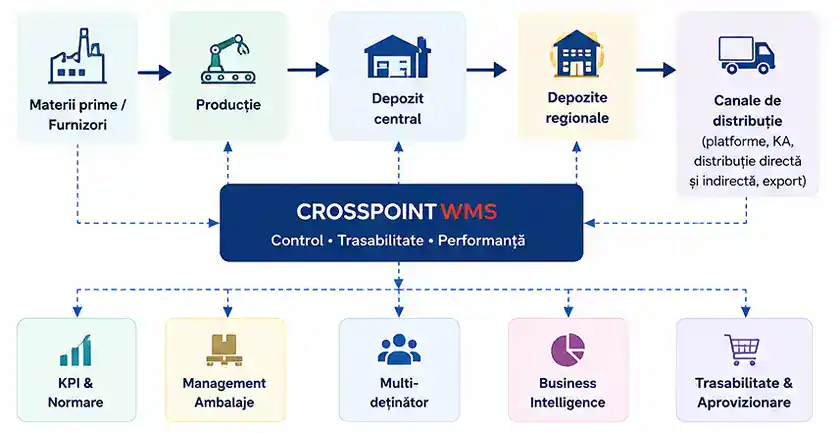
The Alka case study demonstrates how Crosspoint WMS can scale from a central warehouse to a broader logistics network while maintaining inventory accuracy, traceability and operational consistency.
These results clearly reflect the key Crosspoint WMS benefits achieved through process standardization, automation and operational control.
Features Implemented in the Initial Phase
The initial configuration combined Crosspoint WMS features for order preparation, manufacturing integration and inventory optimization, with different rules based on volumes, distribution channels and product characteristics.
Individual Order Preparation
Centralized Order Preparation
Kitting
Manufacturing Integration
Supplier SSCC
Inventory Optimization
Features Implemented Later
As Alka’s operations developed, the Crosspoint suite was extended with additional modules for performance measurement, packaging control, multi-owner inventory management and integration of logistics data with analysis and planning systems.
KPIs & Activity Standards
Packaging Management
Multi-Owner Inventory
Business Intelligence Integration
Traceability & Replenishment
The Point Logistix Perspective

…Operators had no difficulty adapting to the new system. It was user-friendly and reflected their day-to-day work.
Andrei Chiteș
Managing Partner, Point Logistix
In the testimonial:
✔ why the WMS was needed;
✔ implementation stages;
✔ expansion;
✔ results.
The Alka Perspective

…ALKA now also provides services to other FMCG companies that do not have our capabilities, many of which were developed with our partner, Point Logistix.
ALKA has relied on Crosspoint over the past years, and our expectations have never been disappointed.
Cristi Petcu
Deputy General Manager, Alka Trading
In the testimonial:
✔ why the WMS was needed;
✔ results achieved after implementation;
✔ collaboration with the Point Logistix team.
About Alka
Alka is one of the leaders in the Romanian market across most of the categories in which it operates, but the company believes it is defined not by sales figures alone, but by what stands behind them: taste, well-being and the many pleasant surprises offered to consumers.
For more than two decades, Alka has put passion into everything it does, seeking to bring that sense of well-being everywhere through high-quality products and attention to every detail.
Alka

Need a WMS That Can Evolve with Your Operation?
Crosspoint WMS can support higher volumes, process automation and integration with existing systems without requiring the logistics architecture to be rebuilt at every stage of growth.
Why Crosspoint for Complex Logistics Operations?
✔ scalability;
✔ implementations in Romania;
✔ flexible configuration;
✔ local consulting and support;
✔ fast integration;
✔ experience in complex projects.
The Alka case study also shows how a WMS implementation can evolve over time, supporting new warehouses, manufacturing flows and additional logistics services without replacing the core platform.