
Warehouse traceability means more than knowing how much inventory you have and where it is located. In many logistics operations, you also need to be able to quickly answer questions such as: where did the product come from, when was it received, which batch does it belong to, which locations has it passed through, who handled it and in which order was it shipped?
This ability to reconstruct the history of a product, batch, pallet or serial number is the foundation of a modern traceability system.
GS1 defines traceability as a process based on identifying the objects that need to be tracked, capturing the events they pass through and sharing relevant information between participants in the supply chain.
The GS1 Global Traceability Standard defines the principles and requirements needed to build a consistent traceability system across the supply chain.
Within the warehouse, a WMS system can connect this information with the physical operations performed on the goods, creating a history that starts at receiving and continues through to shipping.
For an overview of how this functionality is implemented in Crosspoint, you can also visit the page dedicated to
warehouse traceability.
Traceability means more than simply knowing where a product is
Knowing the current inventory location is only one component of traceability.
If the system shows that 120 units of an item are stored in location A-03-02, we have information about inventory and location.
Warehouse traceability begins when we can also answer questions such as:
- which receiving transaction those 120 units came from;
- who the supplier was;
- which batch they belong to and what their expiry date is;
- when they entered the warehouse;
- whether they have previously been moved;
- who performed the operations;
- which quality checks were carried out;
- whether part of that batch has already been shipped;
- to which customers and through which orders;
- how much of the batch is still in stock.
Warehouse traceability therefore involves connecting multiple logistics events, not simply displaying the current location of a product.
What information should be tracked for complete traceability?
The required level of detail varies depending on the industry, products and processes involved, but a traceability system can use several types of identifiers and information.
Item or SKU
This is the basic level of identification. The system knows which product enters the warehouse, is moved, picked or shipped.
For many operations, however, traceability at SKU level alone is not sufficient.
Batch
Products originating from the same production run or receiving transaction can be tracked separately using a batch number.
This makes it possible, for example, to identify all locations containing a specific batch and all orders in which products from that batch were used.
Serial number
For products that need to be identified individually, traceability can extend down to each unit.
A serial number makes it possible to track a specific product even when other identical products with the same SKU are also stored in the warehouse.
Pallet or logistics unit
In many warehouses, physical movements are not performed product by product, but at pallet, container or other logistics-unit level.
Unique identification of the logistics unit makes it possible to associate products with it and track it through receiving, storage, movements, picking and shipping.
Location
Each event should be associated, whenever relevant, with the location where it took place.
This makes it possible to reconstruct not only the administrative history of the inventory, but also the physical route travelled through the warehouse.
Document and business partner
Receipts, orders, delivery notes, transfers and transport documents provide the commercial context for physical inventory movements.
Through WMS ERP integration and integration with other company systems, an operation carried out in the warehouse can be linked to the document that generated it.
User and time of operation
True operational traceability must also answer the questions:
Who? When? What did they do? To which inventory?
Recording the user, date and time transforms inventory history into a useful tool for investigations, audits and process analysis.
How warehouse traceability is built from receiving to shipping
Traceability is not a separate operation performed at the end of the process. It is built progressively by recording the events that occur throughout the logistics flow.
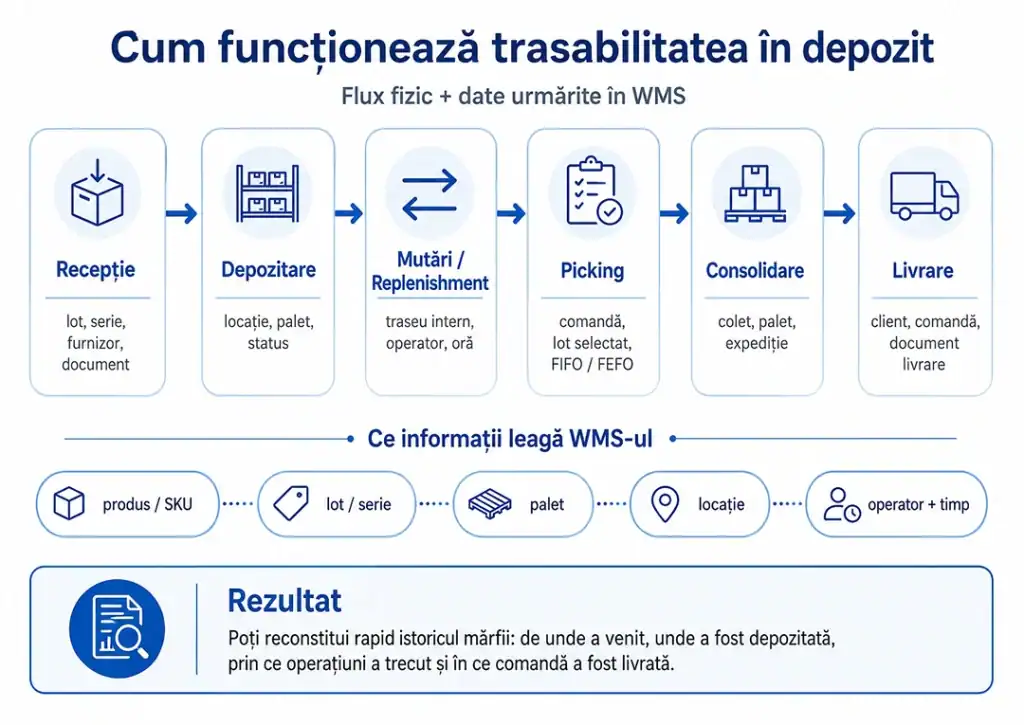
1. Goods receiving
The first critical point is the moment when goods enter the warehouse.
Depending on the product and company requirements, the following information may be recorded:
- item;
- quantity;
- supplier;
- receiving document;
- batch;
- serial number;
- manufacturing date;
- expiry date;
- quality characteristics or statuses;
- pallet or logistics unit.
If the required information is not captured correctly at receiving, it may become difficult or even impossible to reconstruct later.
For this reason, traceability effectively begins when the goods are identified, not when a problem occurs.
2. Put-away and storage
After receiving, products are allocated to storage locations.
A WMS can record the relationship between a product, batch or pallet and the location where it is stored.
If the pallet is moved later, its current location changes, but the history of previous operations must be retained.
The system can therefore answer both:
“Where are the goods now?”
and:
“Where have these goods been?”
This distinction is fundamental to the difference between simple inventory management and warehouse traceability.
3. Movements and replenishment
Inventory may pass through several locations before being allocated to an order.
For example:
Receiving → buffer area → reserve storage → picking location → consolidation → shipping
Each transfer represents a new traceability event.
During replenishment, the system must preserve the connection between inventory transferred from reserve storage and its original batch, pallet or other characteristics.
Physical movement must not break the information chain.
4. Picking
When an order is prepared, another important relationship is created:
Physical inventory → customer order
The system can record which item, batch, serial number or pallet was picked and for which order.
In industries where expiry dates are important, rules such as FIFO or FEFO can be applied so that inventory selection follows the defined strategy.
From a traceability perspective, however, the essential requirement is that after picking it must be possible to determine exactly which inventory was included in each order.
5. Consolidation and shipping
Before shipment, picked products may be consolidated into parcels, pallets or shipments.
Traceability must preserve the relationship between:
Product → batch/serial number → order → parcel/pallet → shipment → customer
Once the goods leave the warehouse, this history does not lose its value.
On the contrary, it becomes essential if a complaint, return, non-conformity or requirement to identify a particular batch arises later.
Backward and forward traceability
A well-designed system should allow information to be queried in both directions.
Backward traceability
Starting from a product or shipment, we can determine:
Customer → order → product → batch → receipt → supplier
This is useful when investigating the origin of a product or the cause of a problem.
Forward traceability
Starting from a received batch, we can determine:
Supplier → receipt → batch → inventory → orders → customers
This becomes particularly important when a problem is identified with a specific batch and the company needs to quickly determine where products from that batch are still stored and where they have already been shipped.
Why is batch traceability important?
Suppose a supplier informs the warehouse that batch L240815 of a product needs to be investigated.
Without a warehouse traceability system, the team may have to reconcile receiving documents, Excel files, shipping documents and information from several applications.
When the data is correctly connected, the investigation can begin directly with the batch.
The system can identify:
- the receiving transaction through which the batch entered the warehouse;
- the initial quantity;
- the locations where inventory from the batch is stored;
- any subsequent movements;
- the quantity already consumed or shipped;
- the orders in which the batch was used;
- the customers who received the products;
- the operators and operations involved.
The challenge is no longer finding the information, but deciding what action should be taken based on it.
Traceability is also important for quality control
Traceability does not only monitor movements.
A batch or pallet may pass through several statuses:
Received → under inspection → accepted → blocked → released for shipping
Within a WMS, inventory status can be linked to logistics operations so that non-conforming products or products under inspection can be separated from available inventory.
The history can later be used to establish:
- when the problem was identified;
- which inventory was affected;
- what decision was taken;
- who made the change;
- when the inventory was released or rejected.
Traceability therefore also provides a foundation for quality-control processes.
Traceability and regulatory requirements
Traceability requirements vary significantly between industries.
In the food sector, for example, European legislation explicitly defines requirements concerning the traceability of food, feed and ingredients throughout production, processing and distribution.
Regulation (EC) No 178/2002 includes the requirement for operators to identify suppliers and the businesses to which relevant products have been supplied.
In other industries, the required level of traceability may range from batch tracking to individual product serialisation.
For this reason, there is no single traceability configuration suitable for every warehouse.
Process analysis and WMS consulting allow the system to be configured according to the risk, value, characteristics and obligations associated with the products being handled.
The role of the WMS in warehouse traceability
A WMS does not create value simply by storing a database of batches and locations.
Its role is to connect physical movement with the corresponding system transaction.
The operator scans or confirms an operation, and the system records the corresponding event:
Which object → from which location → to which location → through which operation → at what time → by whom
Over time, these transactions form the operational history of the goods.
With appropriately configured WMS functionalities, the system can allow inventory and history to be queried using criteria such as item, batch, serial number, pallet, location, document, supplier, customer, user or time of operation.
Can a WMS provide complete traceability on its own?
Not always.
A WMS primarily controls the logistics events taking place within its operational area.
But a product may have a much longer history:
Supplier → production → transportation → warehouse → distribution → customer
For end-to-end traceability across Supply Chain Management processes, information must be transferred between the systems and organisations involved.
This may require integration between:
- ERP;
- WMS;
- MES;
- TMS;
- quality-control systems;
- suppliers;
- 3PL operators;
- customers or distributors.
The WMS is therefore a very important component of the traceability chain, but end-to-end traceability results from data continuity across all relevant stages, not from a single application.
Practical example: traceability between production and warehouse
A relevant example is the Crosspoint implementation at ALKA.
Integration between WMS and ERP made it possible to generate unique identifiers for pallets transferred from production, ensuring that products received at the end of the production line retained their identity throughout subsequent logistics flows.
In these processes, a WMS for manufacturing must preserve information continuity between raw materials, production and finished-goods inventory.
The later extension of the solution to raw materials made it possible to build traceability across a broader flow, from procurement and raw materials through to the finished product delivered to the customer.
You can find more details in the
ALKA WMS case study.
This example highlights an important principle: traceability becomes more valuable as information remains connected across processes and systems.
How can you assess the level of traceability in your own warehouse?
A simple test is to select a random batch or product and try to quickly answer several questions:
- When did it enter the warehouse?
- Which supplier did it come from?
- Through which document?
- Where is it now?
- Which locations has it passed through?
- Who performed the operations?
- How much inventory remains?
- Which orders was it included in?
- Which customers received it?
- Were there any blocks or quality inspections?
- Can all this information be obtained from a single system?
The final question is often the most important.
A company may possess all the necessary data and still have poor warehouse traceability if the information is fragmented across documents, spreadsheets, ERP systems, standalone applications and manual records.
True traceability does not simply mean that the data exists. It means being able to connect and use that data quickly.
From inventory records to the complete history of goods
A well-controlled warehouse must know what is in stock and where the goods are located.
A warehouse with traceability can go much further: it can explain how each product arrived at its current location and what happened to it along the way.
Receiving, storage, movements, replenishment, picking and shipping are no longer independent operations. They become successive events in the same logistics history.
As the number of items, batches, locations, customers and operations increases, maintaining these relationships manually becomes increasingly difficult.
A WMS allows traceability to be built during the execution of warehouse operations rather than reconstructed afterwards from documents.
This level of control contributes directly to the main Crosspoint WMS benefits, from reducing errors to increasing productivity and operational visibility.
Do you need better warehouse traceability?
Crosspoint WMS can be configured to track products, batches, serial numbers, pallets, locations and operations throughout the entire warehouse flow.