
A WMS Designed for 3PL Logistics
WMS for 3PL – Complete Control of Multi-Client Warehouses
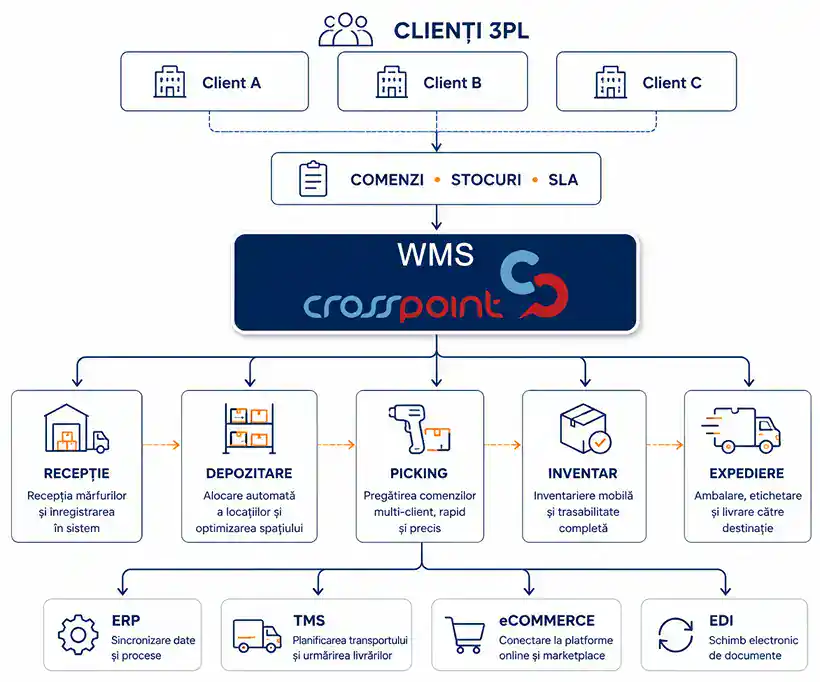
A WMS for 3PL must manage multiple clients, separate inventory, different operating rules, SLAs, documents and traceability requirements within the same warehouse. Crosspoint coordinates these processes in a single platform while maintaining full control for each customer.
Multi-Client Management
Manage multiple clients simultaneously from a single WMS platform, each with its own inventory, logistics rules, operational workflows and service levels (SLAs).
Complete Traceability
Ensure warehouse traceability for every client by tracking lots, serial numbers, pallets and locations in real time from receiving through delivery.
Operational Control
Track productivity, SLA compliance and performance indicators for each client, with continuous access to up-to-date information for faster decisions.
≈ 2.5 million

WMS for 3PL – Integration with the Logistics Ecosystem
Logistics Automation
Reduce errors and improve productivity.
ERP, TMS & eCommerce Integration
Maintain a unified logistics flow.
SLA & KPI
Monitor performance in real time.
Visibility
Keep data continuously up to date.
Scalability
Scale as your business grows.
What Is a WMS for 3PL Logistics?
Third-Party Logistics (3PL) providers manage inventory, orders and operations for multiple clients simultaneously, each with its own requirements and workflows.
Unlike a warehouse dedicated to a single company, a 3PL warehouse must ensure inventory separation, complete traceability, SLA compliance and fast access to information for every customer.
Details
- customers and suppliers;
- sales orders;
- purchase orders;
- delivery notes and logistics documents;
- receipts;
- shipments;
- available inventory;
- lots and serial numbers;
- expiration-date data;
- storage locations;
- inventory counts;
- order status.
Synchronization can take place in real time or at configurable intervals, depending on company requirements and the way the existing ERP system operates.
Which Systems Can Crosspoint Integrate With?
For a 3PL logistics provider, efficiency depends on fast communication between all applications in use. Crosspoint WMS acts as the operational hub of the warehouse, providing WMS–ERP integration together with TMS and the other applications used to automatically synchronize orders, inventory, transport and logistics documents. The result is a continuous flow of information, complete visibility and significantly faster processes.
Details
- ERP;
- TMS (Transport Management System);
- eCommerce platforms;
- marketplaces;
- EDI (Electronic Data Interchange);
- courier systems;
- BI and reporting applications;
- custom software solutions through APIs.
Thanks to its flexible architecture, integration can be adapted to existing processes without requiring major changes to the company’s IT infrastructure.
WMS for 3PL – Essential Features
Multi-Client
Multi-Warehouse
Wave Picking
Cross-Docking
FIFO / FEFO
Barcode Scanning
Customer Portal
Operational KPIs
Benefits of a WMS for 3PL
Higher Processing Capacity
Automation enables a larger number of orders to be handled without a proportional increase in staffing.
Lower Operating Costs
Fewer errors, fewer returns and less time spent on repetitive operations.
Real-Time Visibility
All clients have access to up-to-date inventory and order information.
More Competitive Logistics Services
Providers can offer value-added services and respond faster to market requirements.
A WMS for 3PL gives logistics operators a unified way to manage client-specific workflows while keeping inventory, service levels and traceability clearly separated.
For a complete view of the system’s impact on warehouse operations, see all Crosspoint WMS benefits.

Specific Challenges for a 3PL Logistics Provider
A 3PL provider’s operation is significantly more complex than managing a warehouse dedicated to a single client. Simultaneously managing inventory, orders and logistics services for different companies requires a high level of automation, traceability and operational control.
Details
Managing Multiple Clients Simultaneously
In a 3PL operation, complexity is determined not only by the volume of goods, but also by the number of rules, exceptions and service levels that must be managed simultaneously for different clients.
Each client has its own products, storage rules, picking methods and reporting requirements. The WMS must manage these specific requirements without compromising operational efficiency.
Inventory Separation
Products belonging to different clients must remain logically separate even when stored in the same physical location.
Different SLAs
Receiving, order-preparation and delivery times can vary from one client to another and must be monitored continuously.
Fluctuating Volumes
Promotional campaigns, seasonality and eCommerce can create significant variations in processed volumes.
Complete Traceability
Every product must be tracked from receiving through delivery, including lots, serial numbers and expiration dates.
Industries Using WMS for 3PL
Crosspoint WMS is used by logistics providers managing multi-client warehouses and complex processes for companies across many industries. The platform’s flexibility allows workflows to be configured for each client, regardless of industry.
Details
Retail & eCommerce
Managing high-volume orders, integration with marketplaces and online platforms, and rapid processing of orders and returns.
FMCG
Managing fast-moving products, optimizing picking and continuously updating inventory to support on-time deliveries.
Food Industry
Complete traceability for lots and expiration dates, compliance with food-safety requirements and efficient management of receiving and delivery.
Pharma & Medical Products
Strict control of serial numbers and lots, complete traceability and compliance with pharmaceutical-industry requirements.
Automotive
Managing a large number of part numbers, rapid component identification and synchronization with manufacturing and distribution processes.
Fashion
Managing product variants such as size, color and model, seasonal inventory processing and efficient returns management.
Electronics
Traceability by serial number and unique codes, warranty control and management of high-value products.
B2B Distribution
Managing complex orders, preparing shipments to distribution networks and monitoring performance indicators for each client.
Regardless of industry, Crosspoint WMS can be configured for the specific requirements of each 3PL client, providing complete traceability, logistics-process automation and real-time visibility across warehouse operations.
How Does Crosspoint Address the Challenges of 3PL Providers?
Crosspoint WMS is designed for the specific requirements of 3PL logistics providers, where flexibility, traceability and automation are essential. The platform enables multiple clients to be managed simultaneously, each with its own operational rules, while maintaining complete visibility across all warehouse activities.
✔ Multi-client management from a single platform
✔ Automation of logistics processes
✔ Complete traceability
✔ SLA and performance monitoring
✔ Integration with existing systems
✔ Scalability for business growth
By combining automation, traceability, integration and real-time monitoring, Crosspoint WMS helps 3PL logistics providers reduce operating costs, improve productivity and deliver a consistently high level of service to every client. The result is a more efficient warehouse, standardized processes and greater capacity to support business growth.
Frequently Asked Questions About WMS for 3PL
What Is a WMS for 3PL?
Can It Integrate with the Existing ERP?
How Are Lots and Serial Numbers Tracked?
How Are SLAs Enforced?
Can the System Be Expanded Later?
Multiple Clients in the Same Warehouse?
Can It Manage Multiple Warehouses?
Standard WMS vs. WMS for 3PL
See How Crosspoint Can Optimize 3PL Warehouse Operations
Why Do Logistics Providers Choose Crosspoint WMS?
✔ scalability;
✔ implementations in Romania;
✔ flexible configuration;
✔ local consulting and support;
✔ rapid integration;
✔ experience with complex projects.