
A WMS for Manufacturing
WMS for Manufacturing – Synchronizing Production and Warehouse Flows
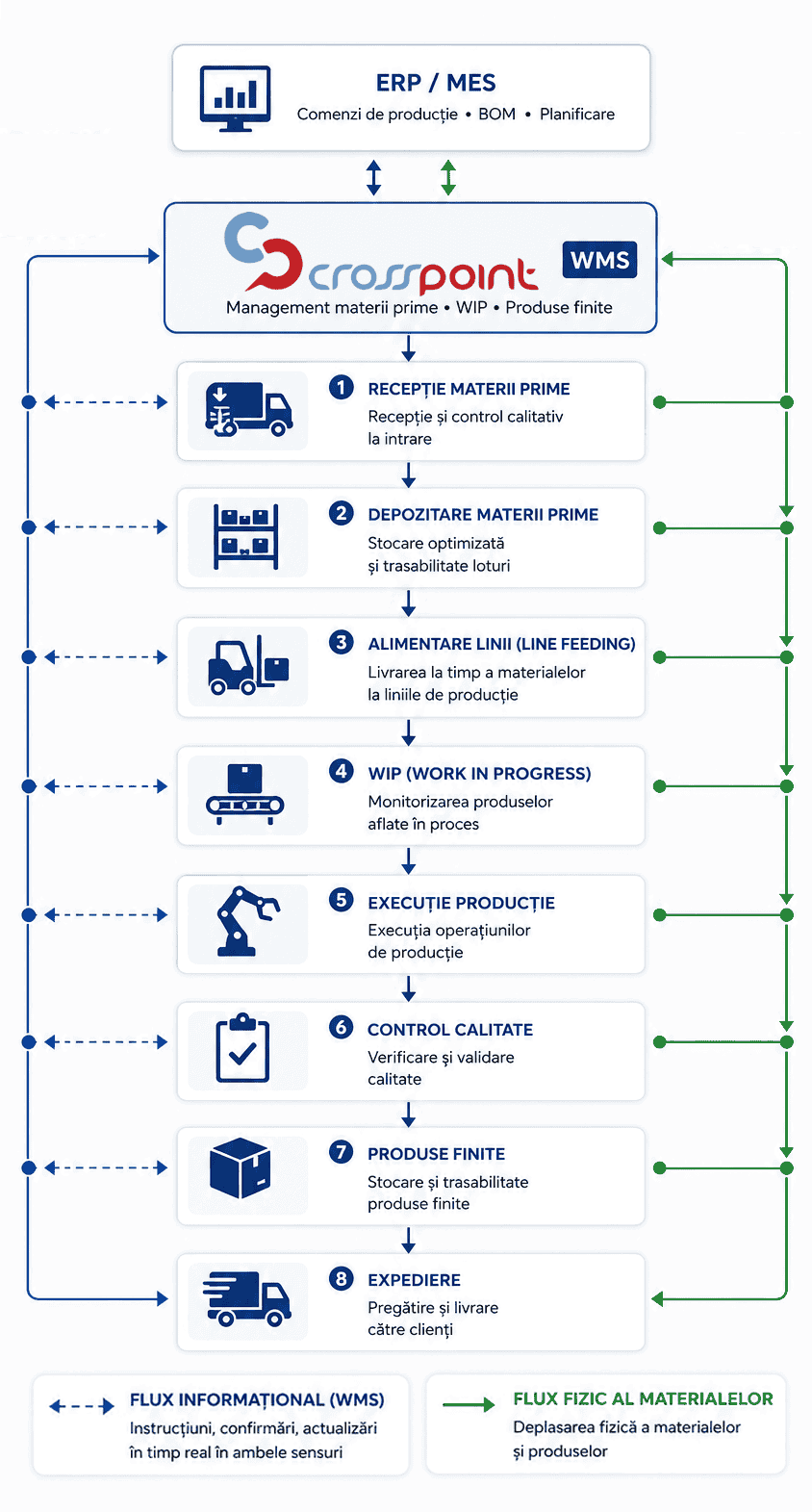
A WMS for manufacturing must synchronize warehouse operations with production flows, from raw materials and line feeding to WIP, finished goods and traceability. Crosspoint connects these processes within a single system and provides control over inventory movements throughout the operational cycle.
Integrated Logistics Flow
Integrate the warehouse with manufacturing processes, from raw-material receiving through finished-goods shipping, in a unified and efficient logistics flow.
Complete Traceability
Ensure complete traceability of raw materials, WIP and finished products, with real-time visibility into every movement and operation.
Operational Control
Optimize line feeding, monitor operational performance and reduce downtime through continuous access to up-to-date data.
9 regional warehouses

WMS for Manufacturing – Integration with the Logistics Ecosystem
INPUT
What enters the system
ERP / MES
Production orders, planning and operational statuses.
BOM / Recipes
Product structures, components and planned consumption.
Raw Materials
Quantities, characteristics, lots and expiration dates.
Lots & Serial Numbers
Data required for traceability throughout the flow.
Operational Rules
FIFO/FEFO, priorities, locations and feeding rules.
Master Data
Items, units of measure, locations and master data.
OUTPUT
What comes out of the system
Updated Inventory
Raw materials, WIP and finished products in real time.
Complete Traceability
History by lot, serial number and operation.
Confirmed Consumption
Quantities used in production and variances from plan.
Production Status
Visibility into orders and stages in progress.
KPIs & Reports
Productivity, processing times and operational KPIs.
Finished Goods Available
Inventory ready for storage, allocation and shipping.
What Is a WMS for Manufacturing?
WMS systems designed for manufacturing manage the complete material flow, from raw-material receiving through the shipment of finished products.
Within Supply Chain Management processes, the WMS is the operational layer that synchronizes inventory and physical movements with planning and production.
Details
Unlike a conventional warehouse, manufacturing operations must coordinate production-line feeding, work-in-process (WIP) monitoring, lot traceability and continuous synchronization with ERP and MES.
Crosspoint WMS provides real-time visibility into inventory and processes, reducing supply lead times and eliminating interruptions caused by material shortages.
Crosspoint WMS manages:
- raw-material receiving;
- lots, serial numbers and expiration dates;
- material storage and allocation;
- production-line feeding (Line Feeding);
- work in process (WIP);
- consumption and internal transfers;
- finished products;
- real-time inventory counting;
- order preparation and shipping.
- complete traceability;
Lot and serial-number traceability is implemented using good practices based on international GS1 traceability standards.
Crosspoint WMS Integration in Manufacturing
In a manufacturing environment, efficiency depends on continuous synchronization between planning, the warehouse and production lines. Crosspoint WMS acts as an operational hub that provides WMS–ERP integration, together with MES and the other applications used in the plant, delivering real-time data on materials, consumption and finished products.
Details
Crosspoint WMS can integrate with:
- ERP;
- MES (Manufacturing Execution System);
- SCADA systems and industrial automation;
- RF terminals and barcode scanners;
- label printers;
- weighing systems;
- Pick-to-Light / Put-to-Light equipment;
- BI and reporting platforms;
- custom applications through APIs.
Crosspoint WMS can integrate with ERP and MES according to the principles defined by the ISA-95 standard for enterprise and manufacturing systems integration.
Thanks to its flexible architecture, integration can be adapted to existing processes without major changes to the IT infrastructure.
WMS for Manufacturing – Specific Features
Line Feeding
WIP Management
Lot and Serial-Number Traceability
FIFO / FEFO
Mobile Terminals & Scanning
Continuous Inventory
ERP / MES Integration
Operational Monitoring
Benefits of Implementing Crosspoint WMS for Manufacturing
Continuous Material Flow
Ensures production lines are supplied on time and reduces the risk of stoppages caused by material shortages.
Reduced Downtime
Automation accelerates receiving, line feeding and internal transfers.
Complete Traceability
Every lot, serial number and operation can be tracked from raw-material receiving through the finished product.
Quality and Compliance
Supports adherence to operating procedures and the specific requirements of regulated industries.
Higher Productivity
Operators work more efficiently and processes are optimized by eliminating manual activities.
Data-Driven Decisions
Real-time indicators support performance monitoring and production optimization.
Complete Production Control
Continuous visibility into raw materials, WIP, finished products and production orders in progress.
Lower Operating Costs
Fewer errors, lower material losses, less excess inventory and fewer manual interventions.
For a complete view of the system’s impact on logistics operations, see all Crosspoint WMS benefits.

Specific Challenges of Modern Manufacturing
In manufacturing, efficiency depends on continuous synchronization between the warehouse, production lines and ERP or MES systems. Limited visibility into raw materials, delayed line feeding or inefficient management of work in process (WIP) can cause costly stoppages and delivery delays.
Details
Production-Line Feeding
Materials must be delivered at the right time and in the required quantity to avoid interruptions to the manufacturing process.
Work-in-Process (WIP) Management
Continuous monitoring of products in progress enables bottlenecks to be identified quickly and production flow to be optimized.
Raw-Material Traceability
Every lot used must be tracked throughout the flow, from receiving through the finished product.
Dynamic Planning
Changes to production orders and priorities must be reflected immediately in warehouse activity.
Consumption Control
Accurate recording of consumption and variances between planned and actual usage helps reduce operating costs.
Who Uses WMS for Manufacturing?
Crosspoint WMS is used by manufacturing companies that require complete traceability, integration between warehouse and production processes, and efficient line feeding. The platform’s flexibility allows logistics workflows to be adapted to the specific requirements of each industry.
Details
Food Industry
Management of lots and expiration dates and compliance with HACCP requirements.
Pharmaceutical Industry
Complete traceability and compliance with validation and regulatory requirements.
Automotive
Just-in-Time line feeding and component management across complex workflows.
Electronics
Control of components, serial numbers and high-value products.
Chemical Industry
Management of raw materials and products with special storage requirements.
Construction Materials
Management of raw materials and finished goods in high-volume plants and warehouses.
Processing Industry
Coordination of material, semi-finished and finished-goods flows across complex manufacturing processes.
How Does Crosspoint WMS Address Manufacturing Challenges?
Crosspoint WMS is designed to synchronize the warehouse with production processes, ensuring raw-material availability, monitoring work in process (WIP) and maintaining complete traceability across logistics flows. Through integration with ERP and MES, operations are coordinated in real time, reducing waiting times and eliminating errors caused by manual processes.
Benefits:
✔ Automated production-line feeding (Line Feeding)
✔ Complete management of raw materials, WIP and finished products
✔ Traceability by lot, serial number and consumption
✔ Integration with ERP, MES and industrial equipment
✔ Real-time visibility into production and inventory
✔ Reduced downtime and production stoppages
By automating logistics flows and continuously synchronizing warehouse and manufacturing operations, Crosspoint WMS helps increase productivity, reduce operating costs and improve control across the entire production process.
Frequently Asked Questions About WMS for Manufacturing
What Is a WMS for Manufacturing?
Can It Integrate with ERP and MES?
How Are Production Lines Supplied?
How Are Lots and Serial Numbers Tracked?
Can Work in Process (WIP) Be Managed?
Can It Manage Multiple Plants / Locations?
Can It Reduce Production Downtime?
Without WMS vs. WMS for Manufacturing
See How Crosspoint Can Optimize Production-to-Warehouse Flows
Why Do Manufacturers Choose Crosspoint WMS?
✓ automated production-line feeding (Line Feeding);
✓ complete traceability for raw materials, WIP and finished products;
✓ integration with ERP, MES and industrial equipment;
✓ real-time monitoring of inventory and consumption;
✓ reduced downtime and production stoppages;
✓ flexible implementation, local consulting and support.