
SUPPLY CHAIN MANAGEMENT
Supply Chain Management (SCM): Control and Integration Across the Entire Logistics Chain
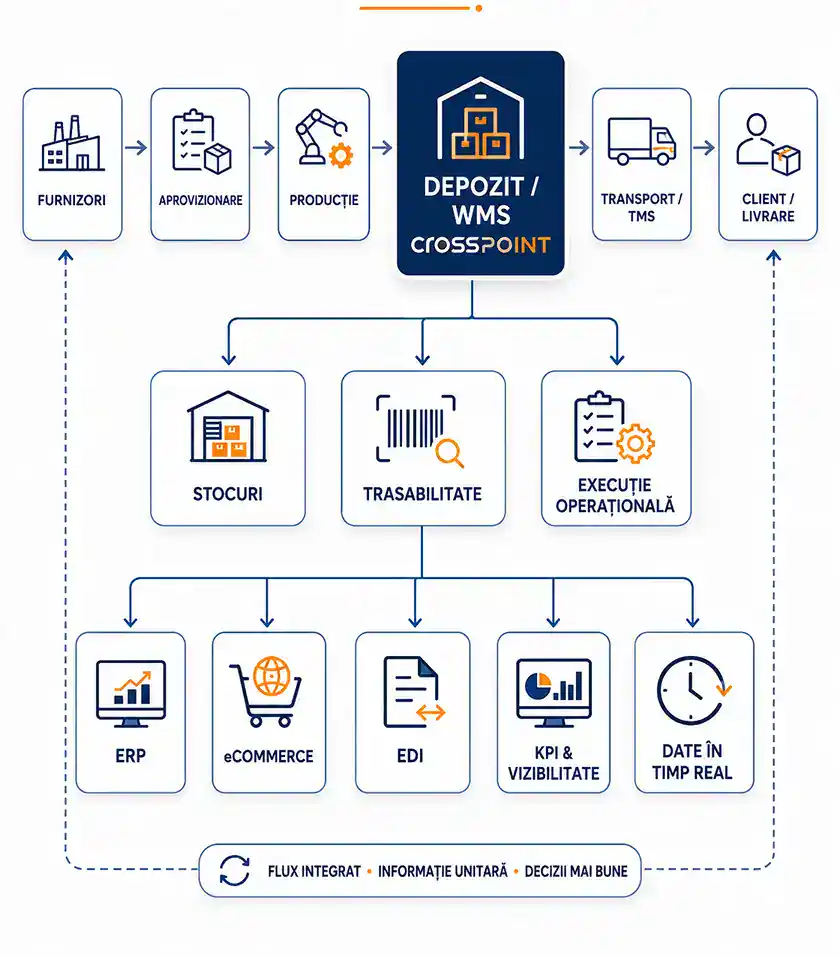
Crosspoint WMS integrates warehouse operations into this ecosystem, providing control over inventory, traceability and logistics execution.
Planning and Synchronization
Coordinate demand, procurement, manufacturing and inventory availability to maintain continuity across the logistics flow.
Logistics Execution
Turn orders and plans into concrete receiving, storage, picking, shipping and delivery operations.
Supply Chain Coordination
Connect suppliers, warehouses, manufacturing, transport and customers in a coherent operational flow.
SCM Diagram – The Role of WMS in the Supply Chain
END-TO-END VISIBILITY
Track flows and information from supplier to customer.
SYSTEM INTEGRATION
Connect ERP, WMS, TMS, MES, eCommerce and EDI within a coherent information flow.
INVENTORY CONTROL
Maintain up-to-date information on availability, locations and movement of goods.
TRACEABILITY
Link products, lots, operations and documents throughout the entire logistics flow.
KPIs & DECISIONS
Turn operational data into relevant indicators for control and optimization.
What Is Supply Chain Management?
Supply Chain Management (SCM) is the coordination of the processes, resources and information involved in moving products from suppliers to the final customer.
A supply chain can include procurement, manufacturing, warehousing, inventory management, order preparation, transport, delivery and returns. The performance of the overall system depends not only on the efficiency of each activity, but also on how these processes are connected.
In a modern company, information moves together with the goods.
Details
Supply Chain Management is about maintaining exactly this continuity:
Supplier → procurement → manufacturing → warehouse → transport → customer
and, in the opposite direction:
Orders → requirements → inventory → procurement → suppliers
The objective is not merely to move goods, but to synchronize demand, inventory, capacity and the resources involved throughout the flow.
According to the Association for Supply Chain Management (ASCM), Supply Chain Management includes planning, execution, control and monitoring of supply-chain activities.
SCM Is Not a Single Software Application
Supply Chain Management is sometimes associated with the idea of a single information system controlling every company process.
In practice, modern architectures often use several specialized applications connected to one another.
For example:
ERP
manages commercial and financial information, orders, suppliers and company documents.
Details
WMS – Warehouse Management System
controls physical warehouse operations, inventory, locations and the execution of logistics tasks.
TMS – Transportation Management System
manages transport planning and execution.
MES – Manufacturing Execution System
controls and monitors manufacturing processes.
EDI and APIs
automate data exchange between applications, suppliers, customers and logistics partners.
BI and dashboards
turn data generated by these processes into indicators and management information.
A high-performance SCM ecosystem does not necessarily require replacing these systems with a single platform. In many cases, the objective is to integrate specialized applications into a coherent information flow.
SCM and WMS Are Not the Same Thing
Supply Chain Management and Warehouse Management System are closely related concepts, but they are not synonymous.
Supply Chain Management
SCM covers the entire chain:
Suppliers
Procurement
Manufacturing
Inventory
Warehousing
Distribution
Transport
Customers
Returns
Warehouse Management System
A WMS focuses on the execution of warehouse operations:
Receiving
Put-Away
Storage
Replenishment
Picking
Consolidation
Inventory Counting
Loading
Shipping
Traceability
The Role of WMS in Supply Chain Management
The WMS is the operational component that controls and synchronizes the processes carried out in the warehouse. Within an SCM architecture, it transforms orders, plans and information from other applications into concrete receiving, storage, picking, consolidation and shipping operations.
Through ERP integration, TMS, eCommerce platforms and other systems, Crosspoint WMS keeps inventory, location, movement and order-status information up to date.
Details
The WMS does not replace Supply Chain Management; it supports it by controlling physical execution in the warehouse. Data generated by operations is transmitted to the other systems so planning and decisions can be based on the actual operational situation.
In companies where the warehouse is directly connected to manufacturing flows, a WMS for manufacturing coordinates inventory and logistics operations with production-line requirements.
The Systems That Build the SCM Ecosystem
Supply Chain Management relies on collaboration between several specialized systems, each controlling a different part of the logistics chain. Value is created when information flows between them quickly and consistently, without manual entry or isolated data.
In a modern architecture, the ERP manages orders and commercial information, the WMS controls warehouse execution, the TMS manages transport, while MES, eCommerce or EDI systems complete the information flow according to the company’s specific requirements.
Details
- ERP – orders, partners, documents and commercial information
- WMS – inventory, locations and execution of warehouse operations
- TMS – transport planning and tracking
- MES – processes and information associated with manufacturing
- eCommerce – orders and product availability
- EDI / API – automated data exchange between systems
How Does Crosspoint WMS Contribute to an Integrated Supply Chain?
Crosspoint WMS connects warehouse execution with the systems and processes that coordinate the entire supply chain. The platform receives orders and relevant information from external systems, controls physical warehouse operations and sends confirmations and updated statuses back.
Warehouse activity therefore becomes a continuous source of data for planning, procurement, transport and delivery processes.
✓ Integration with ERP, TMS, eCommerce and other systems
✓ Automatic inventory and status updates
✓ Visibility into warehouse operations
✓ Traceability for products, lots and movements
✓ Synchronization of orders with logistics execution
✓ Operational data available for KPIs and decisions
See the Crosspoint WMS benefits in detail for operational control, productivity and visibility across logistics processes.
By integrating Crosspoint WMS into the company’s information architecture, warehouse processes no longer operate in isolation. Information flows between connected systems, allowing differences between planning and actual execution to be identified and managed more quickly.
Frequently Asked Questions About Supply Chain Management
What Is Supply Chain Management?
SCM and WMS: What Is the Difference?
Which Systems Integrate Within SCM?
What Role Does WMS Play in the Supply Chain?
Can Crosspoint Integrate with the Existing ERP?
Does SCM Mean Full Automation?
Fragmented Supply Chain vs. Supply Chain Integrated with WMS
Integrating WMS into the SCM ecosystem reduces the gap between planning and what actually happens in the warehouse. Operational data becomes available to other systems, and workflows can be coordinated using up-to-date information.
Integrate Warehouse Execution Across the Entire Supply Chain
See how these principles are applied in real projects and the results achieved in our WMS case studies.
Why Do Logistics Operators Choose Crosspoint WMS?
✔ scalability;
✔ implementations in Romania;
✔ flexible configuration;
✔ local consulting and support;
✔ rapid integration;
✔ experience with complex projects.
For multi-client operations and dedicated logistics services, see the features of a WMS for 3PL.